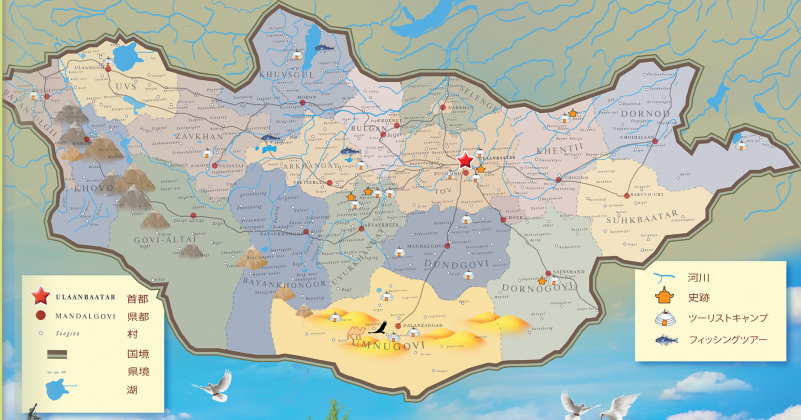
Known as the "Switzerland of Mongolia," Khuvsgul Province (Khuvsgul Aimag) is the country’s northernmost jewel. Famed for its pristine alpine taiga, sweeping valleys, and crystalline waters, it stands as Mongolia's premier destination for nature, adventure, and eco-tourism.
Quick Facts & Key Statistics
Spanning approximately 100,600 square kilometers of high mountain ranges, Siberian larch forests, and vast lake basins, Khuvsgul is home to a population of roughly 128,000 residents. The provincial capital and main transit hub is Mörön, situated about 692 kilometers northwest of Ulaanbaatar. The region is celebrated for its rich ethnic diversity, housing Khalkha, Darkhad, Buryat, Hotgoit, Uriankhai, and Tsaatan communities. Hydrologically, Khuvsgul is Mongolia's most vital water reservoir, holding roughly 70% of the country’s surface freshwater and about 1% of the world's fresh water supply.
Key Travel Attractions & Highlights
Lake Khuvsgul ("The Blue Pearl")
The heart of the province is Lake Khuvsgul (Khuvsgul Nuur), one of the world's ancient lakes at over two million years old. Stretching 136 kilometers in length and dropping to a maximum depth of 262 meters, its waters are so clean that they are safe to drink directly. Surrounded by dense pine forests and snow-capped peaks, visitors can spend days kayaking, taking scenic boat tours, horseback riding, or hiking along the pristine shoreline.
The Darkhad Valley & Tsaatan Reindeer Herders
West of the lake lies the remote Darkhad Basin, a high-altitude wilderness dotted with over 200 small lakes and marshlands. Deep within the surrounding Taiga lives the Tsaatan people, one of the last remaining nomadic cultures in the world to practice forest-based reindeer herding. Travelers journey here to experience their traditional teepee-dwelling lifestyle and learn about their deep connection to the forest landscape.
Shamanism & Ancient Heritage
Khuvsgul is widely considered the spiritual center of Mongolian Shamanism. Unlike regions where Tibetan Buddhism dominates, northern ethnic groups maintain living shamanic practices through ancient rituals, traditional drumming, and spirit worship. History enthusiasts can also explore the Uushigiin Uver Deer Stone Monuments near Mörön—imposing, 3,000-year-old Bronze Age granite pillars intricately carved with flying deer and celestial symbols.
Winter Magic: The "Blue Pearl" Ice Festival
While summer is the peak season for hiking, trekking, and boating, Khuvsgul transforms into a winter wonderland during the colder months. Every March, the frozen surface of the lake hosts the annual Blue Pearl Ice Festival, featuring hand-carved ice sculptures, horse-drawn sleigh races, ice skating, and traditional games held over meter-thick crystal ice.